 Da Vinci
has always been one of my idols as a kid and as an adult. He was and is the epitome of a
Renaissance Man. He was an artist, anatomist, scientist, engineer, innovator, inventor, and centuries before his own time. Many have asked how da Vinci flourished in an environment that almost mandated the best schooling of the time? Part of the answer to this question lies in the answer as to why da Vinci flourished.
Born as a bastard child in 15 April, 1452 to a peasant woman and a notary, he was not really entitled to a formal education. He instead was informally tutored in Latin, geometry, and mathematics. At this young age Leonardo started to show his curiosity.
His lost education would have put him on a course like many students today
thinking that all subjects have to be separate and categorized.
Because of his father and young talent, he was educated as a painter under Verrocchio. While in
Verrocchio's workshop Leonardo would have learn theory and technical skills in many areas relating to art: drafting, chemistry, metallurgy, metal working, plaster casting, leather working, mechanics, carpentry, drawing, painting, sculpting and modelling.
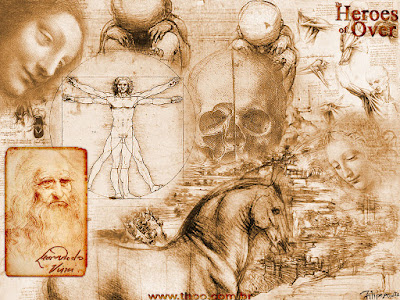
Da Vinci's schooling was unorthodox, yet it enabled him to remain curious and thus creative. For him there really weren't any subjects; there was just knowledge. He made connections between fields. For example, da Vinci became a renowned anatomist (which was very rare during his time because of the Catholic Church's ban on dissecting bodies) in order to be a better painter. He believed that he could paint something accurately only if he knew what happens under the facade. This applies mostly to humans but he also developed basic theories about plat tectonics.
To help explain my point, da Vinci is recorded to have said,
"The Human foot is a masterpiece of engineering and a work of art."


